An assessment and rating visit is booked, the centre director asks you for the cleaning records, and what you can produce is a run sheet and a stack of invoices. That gap is where most trouble with cleaning standards for childcare centres starts. The National Quality Standard doesn’t hand you a list of products and frequencies to tick off. It asks whether the service keeps children healthy and safe, and expects the service to show how. If you’re the one who engaged the cleaner, part of that burden lands on you.
Cleaning standards for childcare centres come from the National Quality Standard, which requires premises and equipment to be kept safe and clean but sets no frequencies. Each service decides its own cleaning routine from the risks in its own rooms, then keeps records showing the routine is followed. A contractor’s job is to make that evidence easy to pull out of a folder.
Where cleaning standards for childcare centres come from
Quality Area 2 covers children’s health and safety, and Quality Area 3 covers the physical environment, including whether premises and equipment are safe, clean and well maintained. Neither sets a cleaning frequency. What an authorised officer looks for is practice: that the service has built a routine answering the infection risk in its own rooms, and can show that routine is followed. You can read the standard itself on the Australian Children’s Education and Care Quality Authority site.
That matters for a contractor because “we clean to the NQS” isn’t a claim anyone can verify. The service is assessed, not the cleaner. So your job is to make the service’s case easier to argue.
Why cleaning records, methods and chemicals all matter
Directors need confidence that cleaning is being carried out properly and consistently. That means knowing which cleaning products are being used, whether the correct methods are followed, and how frequently key areas are cleaned. Records help demonstrate that the agreed routine has been completed, including whether the nappy-change bench was cleaned between uses and what steps were taken after a gastro outbreak. Together, appropriate products, effective cleaning methods and accurate documentation help the centre manage hygiene and infection risks.
In our experience, the cleaning side of that folder is often incomplete for a simple reason. Most cleaning contracts are written as a scope of works, and a scope of works describes what should happen while leaving little evidence of what actually did. It may not tell you whether the high-touch surfaces in Room 3 were wiped on the Tuesday of the outbreak week, which products were used, or whether the agreed cleaning procedures were followed. So if you’re reviewing a contractor, ask what cleaning methods and products they use, as well as what documentation they provide after each clean.
How a cleaning schedule maps to the standard
The useful exercise is to take the areas an officer will look at and write the cleaning routine against each one, in the service’s own words. Four areas do most of the work.
High-touch surfaces. Door handles, light switches, tap handles, gate latches, handrails at child height, bag hooks. These carry the most transmission risk and the least visible soil, which is why they get skipped. They need naming room by room in the schedule, because “wipe down surfaces” doesn’t tell a cleaner at 6pm which surfaces.
Nappy-change and toileting areas. The service will have its own procedure for between-child cleaning, done by educators. The contractor’s work sits underneath that: the end-of-day clean of benches, bins, floors, skirtings and the junction where the bench meets the wall. Split those two responsibilities explicitly in the contract, or each party assumes the other has it.
Kitchens, food areas and outdoor play spaces
Kitchens and food areas. Food handling brings its own obligations, and a childcare kitchen is a commercial kitchen with small people nearby. Kitchen cleaning should specify the equipment covered, the floors and the waste points. It should also say who handles the extraction and the hard-to-reach work that a nightly clean can’t touch.
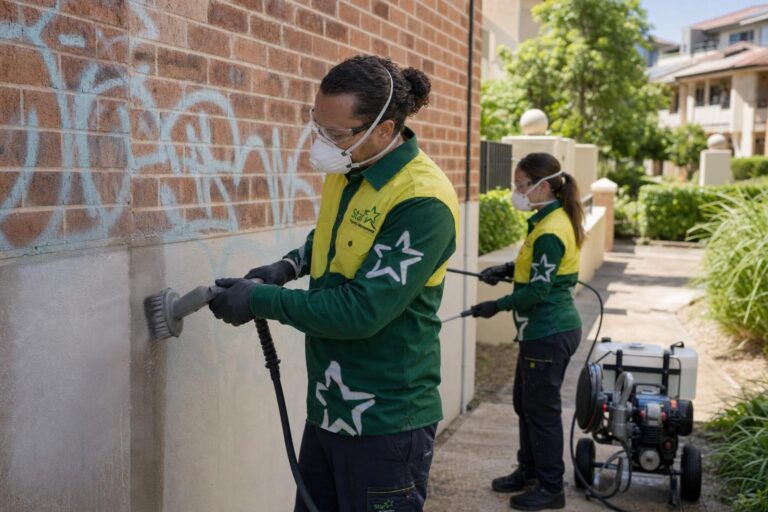
Outdoor equipment and surfaces. Sandpits, soft-fall, climbing frames, shade sails, outdoor tables and paths. Sydney weather does the damage here: bird droppings, leaf fall, mould on shaded play surfaces over a wet winter, and the slippery film that forms on pavers near a dripping tap. Pressure cleaning belongs on a scheduled cycle, so the schedule should name when it happens and what gets done first.
Write those four against your rooms, then add frequencies. The frequencies are a judgement the service makes about its own risk, and that reasoning is what an officer wants to see behind the paperwork.
What a contractor should be able to show you
Before you sign or renew, ask for the following and look at what comes back. If a contractor can’t produce them for an existing site, they won’t produce them for yours.
- A room-by-room schedule naming surfaces and frequencies
- Completion records per visit, signed or logged, kept for the period your service needs
- Safety data sheets for every product used on site, current and on the premises
- A written split of responsibilities between educators and cleaners
- A documented response path for an outbreak or a contamination incident
- Evidence of training in cleaning methods for child-occupied spaces
Plain questions help here too. Ask how the cleaner is trained to handle a soiled area, what cloth and bucket system is used to stop cross-contamination between rooms, and what happens when the regular cleaner is away. Cover arrangements break more schedules than anything else, because the relief cleaner works to a generic routine when nobody has handed them yours.
The questions to put to a contractor at the tender stage
Three questions sort serious contractors from the rest. First: show me the documentation you’d give my centre director the week before an assessment visit. Second: who is accountable on site, and how do I reach them at 6am when the gate is unlocked and the floors aren’t done? Third: what sits outside the nightly scope, and how is that priced and scheduled? Carpet cleaning, hard-floor work, outdoor pressure cleaning and the deep clean after an outbreak all fall in that third category, and a contract that’s silent on them turns every one into a negotiation at the worst possible moment.
The same logic applies across the rest of your portfolio. If you also manage residential common property, the thinking behind a strata cleaning checklist is close to this one: name the surfaces, then record what was done.
Frequently asked questions
No. The standard requires premises and equipment to be kept safe and clean, and leaves the service to set frequencies that suit its own risk. Assessors look for the reasoning and the records behind those frequencies.
Both, at different points. Educators handle cleaning between each child as part of the service’s procedure, while the contractor handles the scheduled clean of benches, bins, floors and surrounds. The contract should state the split in writing.
The cleaning schedule, completion records for recent visits, safety data sheets for products used on site, and any outbreak response records. Keep them in one folder.
Yes. Soft-fall, climbing frames, outdoor tables and shaded paths collect organic matter and grow mould through a wet Sydney winter, so they need a scheduled cycle with a named frequency.
Getting your cleaning schedule assessment-ready
Start with the schedule document itself. Walk one room with your contractor, write down every surface a child touches below adult height, and check whether the current scope names it. That exercise usually finds three or four gaps, and fixing them costs nothing but an afternoon. Then ask for last month’s completion records and see how long they take to arrive.
Disclaimer: This article provides general operational information only and should not be relied upon as a comprehensive guide to regulatory compliance. Childcare centres should check their specific obligations under the National Quality Framework (NQF), applicable food safety requirements, and any other relevant regulations to ensure their cleaning practices meet the requirements for their service.
Star Property Maintenance has worked on Sydney sites since 2002, and is family owned and operated. We provide commercial cleaning for childcare centres, along with grounds maintenance for the outdoor areas, through a combination of in-house teams and trusted specialist contractors, depending on the scope, location and service requirements of each project. If your current schedule wouldn’t survive a close read before an assessment visit, we can walk the site with you and build one that would. Get in touch and we’ll start with the rooms.