A tag appears on the rear wall of a strata block on a Saturday night, and by Monday the building manager has three owners asking when it will be gone. The instinct is to send someone with a pressure washer and get it off before anyone else sees it. That instinct is right about the timing and often wrong about the method, because graffiti removal from brick and render goes badly when the wall is treated as one problem instead of three. Brick, render and painted masonry each fail in a different way, and the damage from a wrong method outlasts the tag by years. Below is how to read the surface, why speed changes the cost, and when a coating starts to pay for itself.
Why the wall decides the method
Paint doesn’t sit on a surface the same way twice. On unsealed brick, aerosol wicks into the pores and down into the mortar joints, so the pigment ends up below the face of the material. On acrylic render the tag sits closer to the surface, but render is soft, and its texture is a finish someone chose and paid for. On a painted wall, the graffiti and the substrate are both paint, so any solvent strong enough to dissolve one has a fair chance at the other. The remover can’t tell the difference between the tag and the wall, and neither can 3,000 psi of water.
Two failures show up again and again on Sydney streets. One is blown-out mortar on older face brick, where the pressure was wound up until the tag faded and the pointing came away with it. The other is a bright patch on a rendered fence, lighter than everything around it, because one section was cleaned hard while the rest of the wall still carried years of weather. Each of those is now a repair with a cost attached.
Reading the surface before you touch it
Four things decide what a wall can take, and they’re worth settling before anyone opens a drum of solvent.
- The substrate. Face brick, render, bagged brick, painted masonry, Colorbond and powder-coated aluminium all behave differently.
- Whether it’s sealed. A sealed or previously coated wall releases paint far more readily than a raw porous one. Water beading on the face is a quick tell.
- Age and condition. Perished mortar, drummy render and flaking paint will come off with the graffiti, whatever you use.
- The finish you need to match. A heritage facade or a colour-matched fence sets a higher bar than the back of a warehouse.
Test patches aren’t a formality. On a tagged wall of any value, treat a small area somewhere inconspicuous, let it dry fully, then look at it in daylight before committing to a whole elevation. Twenty minutes of patience at that stage prevents most of the damage described above, because the patch tells you what the wall will look like afterwards.
Graffiti removal from brick and render: chemical or pressure
Chemical removal is the default on porous masonry. Purpose-made graffiti removers soften the aerosol so it can be lifted or rinsed at low pressure, which means the work is done by the product rather than by force. On brick, that’s the approach most likely to draw pigment out of the pores and the mortar without eroding either. It takes longer than blasting, it needs correct dwell times, and the rinse water has to go somewhere sensible instead of straight into a stormwater pit.
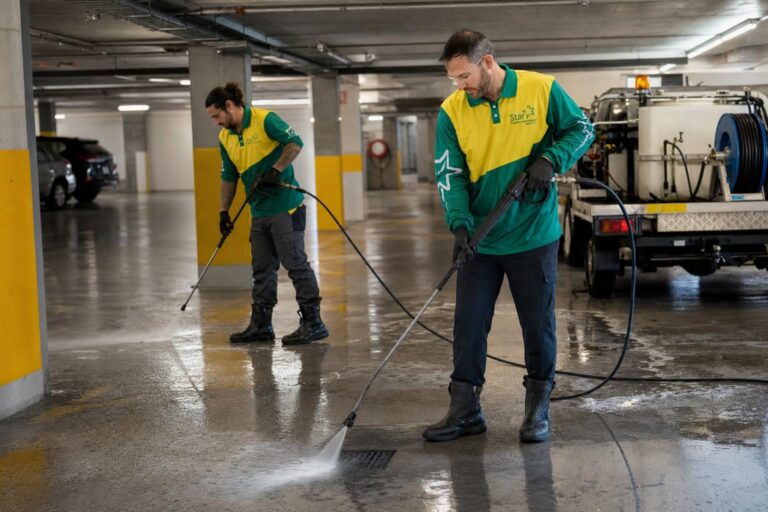
High-pressure cleaning is a rinse stage, not the removal method. Applied after a chemical treatment, at a pressure and nozzle chosen for the substrate, it clears softened residue and leaves a clean face. On its own it etches render, strips paint, drives water into cavities and opens mortar joints. The temptation is strongest on large areas, where chemical treatment looks slow by comparison.
When repainting is the right call
On a painted wall, repainting is usually the honest answer. If the colour can be matched, cleaning and recoating the affected section often gives a better result than any solvent, with no ghosting and no patchy sheen. Keeping a record of the colour and the sheen level turns each incident into a short visit. The trade-off is that patch repaints eventually need a full coat to stay uniform.
Some surfaces need a different trade entirely. Etched glass, scratched powder coating and burnt-in tags on polished stone are replacement or specialist refinishing jobs, and no amount of chemistry changes that.
Why speed matters on a tagged wall
Fresh aerosol hasn’t fully cured or been baked by sun, so it lifts with less product and less effort. Leave it three weeks on a north-facing render wall through a Sydney summer and the binder hardens, the pigment sits deeper in the substrate, and the same tag now needs repeat treatments or a repaint. Cost climbs with it, and so does the chance of a visible difference between the treated patch and the wall around it.
A tagged wall also attracts more tags, so the longer a site carries visible graffiti, the more it accumulates. Graffiti vandalism is a criminal offence in NSW and incidents can be reported to NSW Police, which is worth doing where a site is being hit again and again. For a property manager, the practical version is a standing instruction: anything on a street-facing elevation goes into the next scheduled visit without a round of emails first. Delay works the same way on external walls generally, which is why our guide to commercial mould removal is worth a read if you’re dealing with both on one building.
When an anti-graffiti coating pays for itself
A coating won’t stop anyone tagging the wall. What it changes is what happens afterwards. Sacrificial coatings sit as a barrier over the substrate and come away with the paint when washed, then get reapplied. Permanent coatings stay put and allow repeated cleaning without reapplication, at a higher upfront cost.
The maths is simple enough to do on a phone. Count how many times that wall was hit in the past twelve months and what each clean cost in labour and product. A rear laneway wall tagged once a year rarely justifies coating. A substation enclosure, a car park stair core or a fence on a through-route hit six or eight times a year makes a strong case, because each subsequent clean becomes a wash rather than a chemical treatment, and because the substrate stops absorbing anything.
Coatings also protect the surfaces you can least afford to lose. Face brick and heritage masonry are expensive to restore and very hard to match, so the value sits in never having to attempt that repair, as much as in the cleaning cost. Before coating anything, check the surface is sound, dry and clean, because a coating over failing render locks the problem in behind it.
What to put in your maintenance scope
Write the response into the contract so nobody has to renegotiate it each time a wall gets hit. Name the elevations that get priority, set a response window for street-facing tags, require a test patch on any heritage or finished surface, and ask who holds the colour records for painted sections. Then ask a prospective contractor what they’d use on your specific walls and why. If the answer is about substrate and dwell time, you’re talking to someone who has done it; if it’s about pressure, keep asking.
Star Property Maintenance has worked on Sydney sites since 2002. Graffiti removal, including anti-graffiti coatings, sits alongside the high-pressure cleaning, painting and general property maintenance that the same wall tends to need. Star PM is family owned and operated, working across Greater Sydney for community housing, councils, strata, schools, aged care and commercial properties. If you’ve got a wall that keeps getting hit and you want a straight answer on method and coating, talk to us about the site. Get a free quote.
Frequently asked questions
Yes, with chemical removal and a low-pressure rinse. Brick is porous and mortar is softer than the brick around it, so leaning on water pressure alone is what opens joints and erodes pointing.
As soon as the site can be attended. Fresh aerosol lifts with less product and less effort, and a tagged wall tends to attract further tags the longer it stays visible.
Yes, when the pressure is chosen to beat the tag instead of to suit the surface. Acrylic render is soft and textured, so high pressure cuts into the finish and leaves a patch lighter than the wall around it.
Yes on walls hit several times a year. Later cleans come down to a wash, and the substrate underneath stops absorbing pigment.